
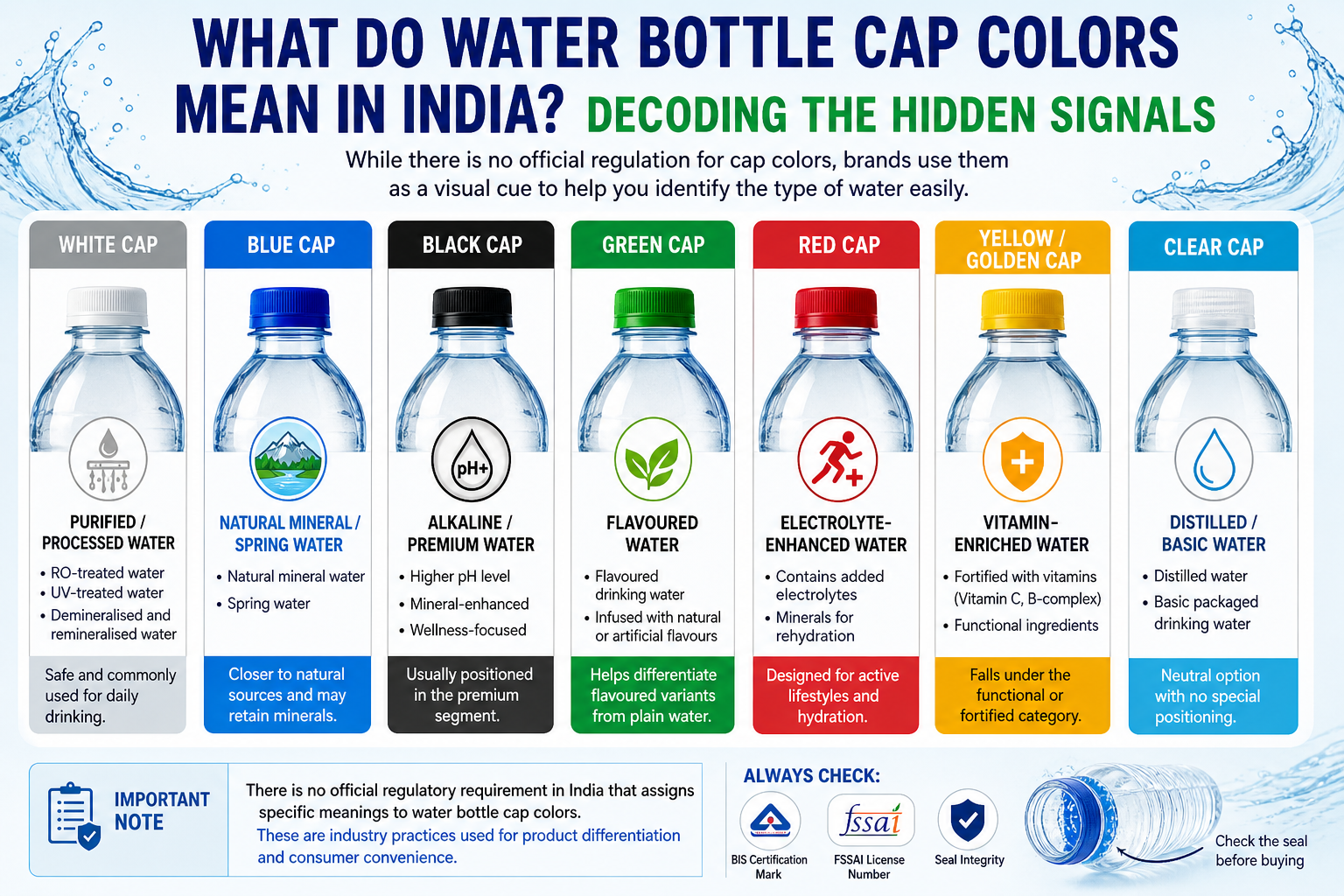
Walk into any store and you’ll find rows of packaged drinking water bottles—almost identical at first glance. But look closely, and you’ll notice a small detail that often goes unnoticed: the color of the bottle cap.
Blue, white, black, green… are these just design choices, or do they actually mean something?
Let’s decode the hidden signals.
Is There an Official Color Code?
In India, packaged drinking water is regulated by the Food Safety and Standards Authority of India (FSSAI) and certified under the Bureau of Indian Standards (BIS).
However, these authorities focus on quality, safety, and labeling—not cap colors.
👉 This means there is no official or mandatory color-coding system for water bottle caps in India.
Then Why Do Caps Have Different Colors?
Cap colors are mainly used by brands as a visual shortcut to:
- Differentiate products on shelves
- Signal product type or positioning
- Build brand identity
Over time, certain informal patterns have emerged across the market.
Common Water Bottle Cap Colors and Their Meanings
While not standardized, these are widely observed associations:
⚪ White Caps – Purified / Processed Water
- RO-treated or UV-treated water
- Demineralized and remineralized water
- Most commonly used for regular packaged drinking water
👉 Safe and widely consumed for everyday use.
🔵 Blue Caps – Mineral or Spring Water
- Natural mineral water
- Spring water
👉 Often positioned as closer to natural sources with retained minerals.
⚫ Black Caps – Alkaline or Premium Water
- Higher pH water
- Mineral-enhanced or wellness-focused
👉 Typically marketed in the premium segment.
🟢 Green Caps – Flavoured Water
- Infused or flavored water
- Sometimes used for herbal or natural variants
👉 Helps distinguish from plain drinking water.
🔴 Red Caps – Electrolyte Water
- Contains added electrolytes
- Designed for hydration and recovery
👉 Common in fitness and sports categories.
🟡 Yellow / Golden Caps – Vitamin Water
- Fortified with vitamins (like Vitamin C, B-complex)
- Functional or health-focused beverages
👉 Positioned as value-added hydration.
🟦 Clear Caps – Basic / Distilled Water
- Distilled water
- Simple packaged drinking water
👉 Neutral appearance with no special positioning.
Why This Matters
In real life, most people don’t spend time reading labels—especially when they’re in a hurry.
Cap colors act like a quick visual guide, helping you:
- Identify product types instantly
- Make faster purchase decisions
- Avoid confusion between similar-looking bottles
Important Reality Check
Here’s where many people get it wrong:
👉 Cap color does NOT guarantee quality
👉 It is NOT a regulated standard
Two bottles with the same cap color may still differ in:
- Source
- Treatment process
- Mineral content
Always check:
- BIS certification mark
- FSSAI license number
- Packaging seal
Final Thought
Water bottle cap colors in India are not just random—they are part of a silent visual language shaped by branding and consumer behavior.
They help you decide faster—but they shouldn’t be your only decision factor.
So next time you pick up a bottle, notice the cap color—but make sure you read the label when it really matters.